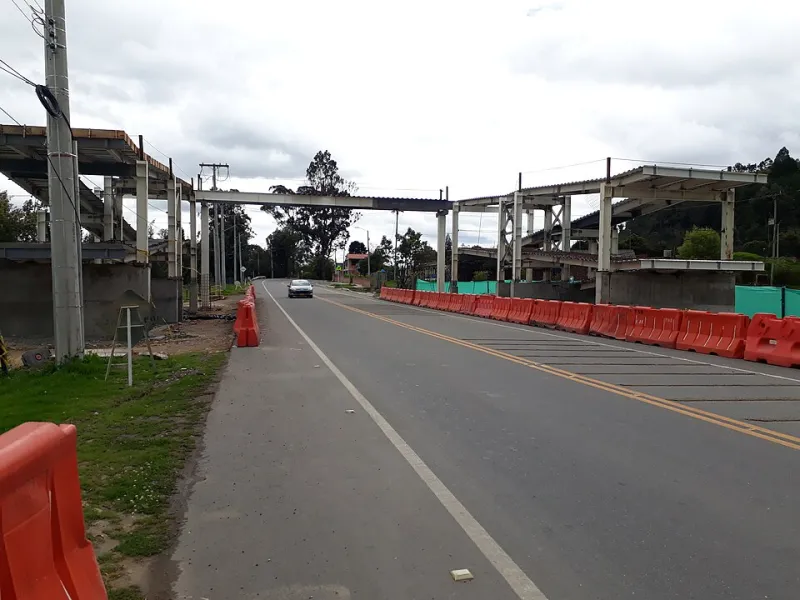
The Corridor Effect: Why the A38, A46 and a Handful of Junctions May Decide the Summit's Next Home

Photo: A.Savin, FAL, via Wikimedia Commons
Ask a room of Midlands contractors where the next decade of work will come from and most will reach for a map before they reach for a balance sheet. The answer, increasingly, is not a city but a corridor. The A38, the A46 and the rail lines threading between them are doing more than moving traffic — they are deciding which towns can credibly bid for major contracts, which industrial sites become viable, and, eventually, where a gathering like the Midlands Construction Summit ought to be held.
Infrastructure as a Sorting Mechanism
Transport schemes have always shaped development, but the current wave of Midlands investment is unusually targeted. Junction upgrades on the A38 around Derby and Burton, long-mooted dualling proposals further south, and steady improvements along the A46 corridor between Newark, Leicester and the M1 are not glamour projects. Their effect, however, is cumulative and profound: they shrink the effective labour catchment around any given site.
"A junction improvement sounds trivial until you realise it turns a ninety-minute commute into fifty minutes," says one senior planner at a district authority who asked not to be named while schemes remain at consultation stage. "That's the difference between being able to staff a distribution hub or a manufacturing plant — or not. And where those plants go, the construction contracts follow."
For main contractors, the arithmetic is blunt. Labour availability within an hour's drive is now one of the first filters applied when deciding whether to bid. A site that was uneconomic five years ago can become competitive simply because a roundabout was rebuilt.
The Tender Map Is Being Redrawn
Several contractors spoken to for this piece point to the same phenomenon: public and private clients are increasingly siting projects along the improved corridors rather than in traditional centres. Land assemblies near the A46 in Leicestershire, logistics and advanced manufacturing schemes around the A38 in Staffordshire and Derbyshire, and the pull of the East Midlands rail freight cluster are all cited as evidence.
"We used to chase the cities — Birmingham, Nottingham, Leicester," says the operations director of a medium-sized civils firm based in the Trent Valley. "Now some of our best pipeline is in market towns that happen to sit twenty minutes from a dualled stretch. The clients figured out that land is cheaper and the workforce can actually get there."
This has consequences for how firms of every size plan. Subcontractors who once clustered near city ring roads are reconsidering their depots. Materials suppliers are watching which stretches of corridor will carry the heaviest HGV movements. Even training providers are rethinking where to base apprenticeship cohorts, on the assumption that the workforce of 2030 will be employed along these spines rather than in the centres.
So Where Does the Summit Go?
Which brings the question home. The Midlands Construction Summit has always drawn delegates from across the region, but venue geography matters more than event organisers like to admit. A venue an hour off the corridor network imposes a real cost on a Derby-based civil engineer or a Leicestershire subcontractor deciding between a day at the Summit and a day on site.
The organisers have, sensibly, kept their options open. But the logic of the corridors suggests the event's long-term centre of gravity may shift — not dramatically, but measurably — towards locations that sit at the interchange of the A38 and A46 catchments, or within easy rail reach of both. If the region's work is concentrating along those spines, the region's industry gathering will eventually feel the same pull.
Some argue this is overthinking it. Delegates travel for content, not postcodes, and a strong speaker line-up will fill any hall in the region. That is partly true. But the Summit's own delegate data, discussed at past events, shows attendance thinning sharply beyond a certain drive time. If the corridor towns become the industry's centre of mass, an event that ignores them is quietly narrowing its own base.
What Delegates Should Watch
For firms planning their next three years, the practical takeaways are straightforward. First, track the pipeline of junction and dualling schemes through National Highways and local authority consultations — these are leading indicators of where tenders will cluster. Second, treat rail freight and station-adjacent schemes as part of the same picture; the corridor effect is multimodal. Third, when assessing bid viability, re-run your labour catchment figures on the post-improvement road network, not the current one.
The Midlands has always been a region defined by how easily things and people move through it. The next decade's construction map is being drawn right now, in consultation documents and junction designs that rarely make the news. The firms that read the tarmac early will be the ones standing first in the queue when the tenders arrive — and quite possibly the ones filling the aisles at whichever hall the Summit calls home next.